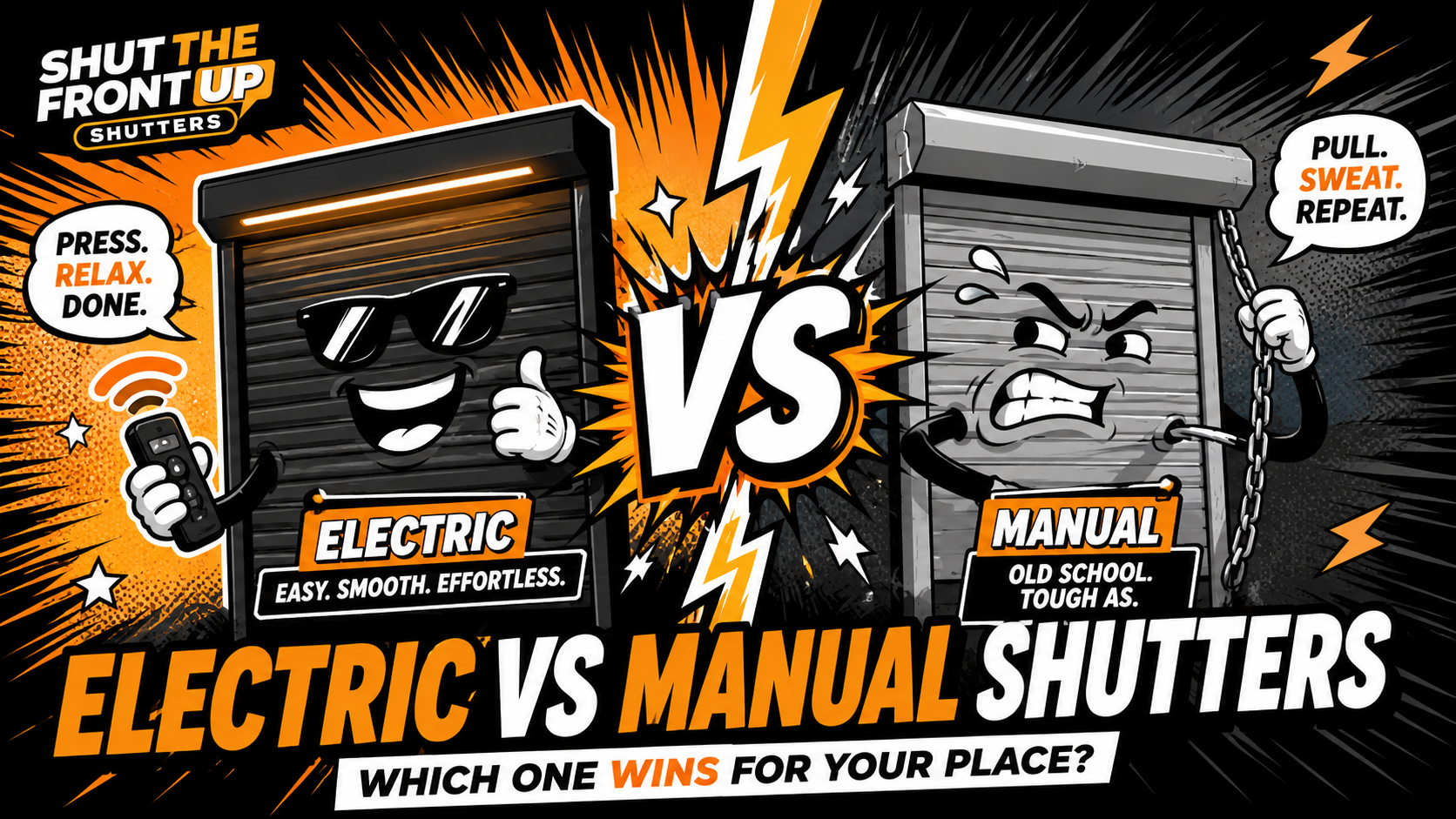
The roller-shutter sales rep has a script. It goes: "the manual is cheaper, but for just \$350 more per window you can have electric, and most of our customers go electric." They're not lying. But the question of whether you should go electric depends on factors the script doesn't really get into.
The price gap in 2026
Roughly \$350-\$500 per window separates a manual shutter from a hard-wired electric one. Across a 10-window house, that's \$3,500-\$5,000, not nothing. Battery-powered electric is a bit cheaper than hard-wired (no electrician) but adds an ongoing consumable (the battery). Solar is the most expensive upfront but cheapest over a 10-year horizon.
Where manual wins
- Small bedroom and bathroom windows you'll crank once at sundown and forget. Two seconds of effort, zero electronics to fail.
- Tight budgets where saving \$2,000 across the house matters more than convenience.
- Holiday homes or rentals where you'd rather not have batteries to maintain or remotes to lose.
- Off-grid or low-power scenarios with no nearby 240V.
- Renters who might take the shutter with them. Manual reinstalls more easily.
Manual shutters are not "old technology that nobody uses". They're a perfectly good choice for windows you operate occasionally. People who say "always go electric" haven't installed eight of them at \$1,200 a pop on a house budget.
Where electric wins decisively
- Wide windows over 1800 mm. Manual operation gets heavy and tedious.
- Windows you'll operate daily. Living, dining, kitchen, master bedroom. The cumulative effort of manual cranking is bigger than people guess.
- High or hard-to-reach windows. Anywhere you'd need a ladder for manual operation.
- Smart-home households who want scheduled drops on hot days. This is impossible with manual.
- Mobility-restricted occupants. Massive accessibility benefit.
- Multi-shutter rooms where a single remote press drops 3+ shutters together.
The honest hybrid approach
Most Australian homes are best served by a hybrid install: electric on the 4-6 windows you use most (living room, master bedroom, kitchen splashback), manual on the smaller windows you basically leave closed. This typically saves 25-40% over an all-electric install while keeping the convenience where you'll actually feel it.
A real-world example
A typical 3-bedroom, 9-window Adelaide home:
- 3 × electric on living, dining, master bedroom: ~\$4,000
- 4 × manual on secondary bedrooms, study, laundry: ~\$2,900
- 2 × electric on big west-facing kitchen windows: ~\$2,700
Total: about \$9,600. All-electric would be ~\$12,000. All-manual would be ~\$7,100. The hybrid lands roughly in the middle, with electric where it matters and manual where it doesn't.
What about retrofitting a motor later?
Yes. Most modern manual shutters can be retrofitted with a motor afterwards. Budget \$400-\$700 per shutter for the motor, parts, and labour. The catch: it's still cheaper to do electric upfront if you're planning to upgrade within five years. Retrofitting also voids some warranties. Check the manufacturer's terms before assuming you can upgrade later.
The motor brand question
If you're going electric, the motor matters more than the shutter slats do. Top picks in 2026:
- Somfy. Gold standard. Reliable, parts widely available, 5-10 year warranty options. Slight premium.
- Becker. German engineering, often spec'd on European-imported shutters. Equally good.
- Simu. French, good warranty, more affordable.
- Generic / unbranded, usually 2-3 year warranty, parts hard to source in 5+ years. Avoid unless your budget really demands it.
The "regret poll" results
Of homeowners we've surveyed who installed all-manual to save money, roughly two-thirds wished they\'d gone electric on at least the living and master bedroom windows. Of those who went all-electric, very few regret it, but some say they\'d have saved on the small bathroom and laundry windows if they had the choice again.
The clearest signal: regret runs in one direction. People wish they\'d gone electric where it counts, not the other way around.
Want quotes that price both options? Request a quote here and ask the installers to break out manual and electric line-by-line. The line items will be educational.